
 On eBay Now...
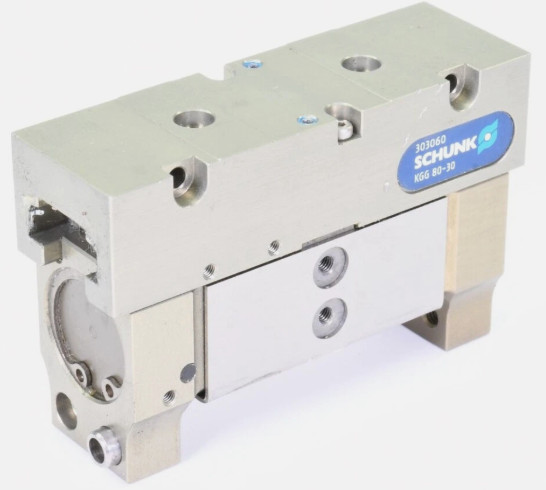
Schunk KGG 80-30 Pneumatic Gripper 0303060 For Sale
When you click on links to various merchants on this site and make a purchase, this can result in this site earning a commission. Affiliate programs and affiliations include, but are not limited to, the eBay Partner Network.

Schunk KGG 80-30 Pneumatic Gripper 0303060:
$300.00
The gripper is pneumatically actuated and operates over a pressure range of approximately 2.5 to 8 bar, with 6 bar nominal operating pressure commonly specified. Its compact pneumatic design provides fast actuation, with published opening and closing times of approximately 0.05 seconds, making the unit well suited to high-cycle automated machinery.
Key specificationsSpecificationKGG 80-30 / 80-30Part number0303060 / 0303060Gripper type2-finger parallel pneumatic gripperApplicationSmall-component handlingStroke per jaw15 mmClosing force130 NOpening force165 NNominal pressure6 barOperating pressure2.5–8 barAir consumption per double stroke12 cm³Closing time0.05 sOpening time0.05 sGripper weight0.25 kgRecommended workpiece weight0.66 kgMaximum finger length80 mmMaximum finger weight0.15 kg per fingerRepeat accuracy0.02 mmProtection ratingIP40Dimensionsapprox. 80 × 26 × 41.3 mmMaximum axial force300 NMax. momentsMx 2 Nm, My 5.5 Nm, Mz 6.3 NmThese specifications are consistent with SCHUNK’s published KGG documentation and current product listings for part 0303060.
Mechanical performanceA notable feature of the KGG 80-30 is its combination of compact size and relatively high gripping force. The gripper weighs only about 250 g, while providing up to 130 N of closing force under the specified conditions. This makes it appropriate for robotic end-of-arm tooling and automated fixtures where minimizing moving mass is important.
The maximum recommended finger length is 80 mm. Longer or heavier fingers can increase the bending moments acting on the gripper and may reduce performance or service life. SCHUNK documentation specifies maximum permissible moments of 2 Nm about Mx, 5.5 Nm about My, and 6.3 Nm about Mz, with a maximum axial force of 300 N.
Accuracy and operating environmentThe KGG 80-30 has a specified repeat accuracy of 0.02 mm, which makes it suitable for applications requiring consistent positioning of repeatedly handled components. The published specifications give an IP40 protection rating. Temperature specifications vary slightly between historical documentation and reseller listings; SCHUNK\'s older catalog documentation specifies an operating range of approximately -10°C to +90°C, while some current listings give a narrower minimum of +5°C. For an engineering application, the applicable SCHUNK datasheet for the specific production revision should therefore be used.
The unit also appears in SCHUNK documentation with a cleanroom classification of ISO 14644-1 Class 7, although this should be verified against the exact configuration and application requirements before specifying it for a controlled-environment installation.
Typical applicationsThe SCHUNK KGG 80-30 is particularly suited to:
- Robotic pick-and-place systems
- Automated assembly machines
- Small-part handling
- Machine tending
- Packaging and sorting equipment
- Component loading and unloading
- Transfer systems
- Automated production fixtures
- General pneumatic gripping applications
Because it is a parallel gripper, the jaws move linearly toward and away from one another. This makes it useful when the workpiece must be positioned accurately and held along defined gripping surfaces. Interchangeable or application-specific fingers can be attached to the base jaws to accommodate the geometry of the workpiece.
Overall descriptionIn summary, the SCHUNK KGG 80-30, 0303060 is a compact, high-speed, two-finger pneumatic parallel gripper for small-component automation. Its 15 mm stroke per jaw, 130 N closing force, 0.02 mm repeat accuracy, and approximately 50 ms opening/closing time make it a practical choice for fast and repeatable industrial handling operations. Its small 80 × 26 × 41.3 mm envelope and 0.25 kg weight are particularly advantageous when it is mounted on a robot or compact automated mechanism.
Part identification: SCHUNK KGG 80-30, OEM part number 0303060. SCHUNK\'s own CAD catalog lists 0303060 as the KGG 80-30 model.
Schunk KGG 80-30 Pneumatic Gripper 0303060
$300.00
$800.00
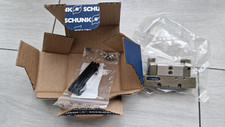
SCHUNK Gripper for small components KGG 70-24 (303055)
$600.00

Popular Tutorials
Alarms and Indicator Circuit diagrams- Power supply failure alarm
- Theft preventer alarm
- Rain Alarm
- A simple electronic buzzer
- Water Level Indicator with alarm
- Stereo Channel Selector
- Low cost intercom using transistors
- Infrared Head Phones
- Use the CD-ROM drive as a audio CD player without the computer
- Audio Visual Indicator for Telephones
- Ultrasonic pest repellent
- Charge Monitor for 12V lead acid battery.
- Wiper Speed Control
- Dome Light Dimmer for Cars
- Car anti theft wireless alarm.
- Control electrical appliances using PC
- Simple Analog to Digital Converter
- PC based Frequency Meter
- 7 segment rolling display using PC
- Electronic Scoring Game
- JAM(Just A Minute) Circuit
- Flashy Christmas Lights
- TV remote control blocker
- Light Flasher (blinking lights)
- Automatic Dual output Display
- Emergency Light
- Automatic Room Lights
- Running Message Display
- Automatic Speed Controller for fans & Coolers
- Soft Button type Motor Direction Controller
- Super simple stepper motor controller
- Discrete component motor direction controller
- Negative supply from single positive supply
- Self switching Power Supply
- Ultra low drop linear voltage regulator
- Car anti theft wireless alarm.
- Long range FM transmitter
- Remote control using VHF modules
- 40 meter Direct Conversion Receiver
- Remote control using VHF modules
- Remote control using telephone
- A simple Remote control Tester
- Clap Activated Remote
- Radio Remote Control using DTMF
- Ultrasonic switch
- Magnetic proximity sensors
- Dew sensor
- Color Sensor
- Metal Detector
- Optical toggle switch using a single Chip
- Telephone Ringer using 556 dual timers
- Two line intercom plus a telephone changeover switch
- Telephone line based audio muting and light on circuit
- Having secrecy in parallel telephones
- Telephone call meter using calculator & COB
- High Resistance Voltmeter
- A simple Remote control Tester
- Contactless Mains Voltage Indicator
- Zener Diode Tester