
Here is a telephone line vigilant circuit to guard against mis- use of your telephone lines. It monitors telephone lines round the clock and provides visual as well as an audio warning (when someone is using your telephone lines) which can be heard anywhere in the house. Another advantage of using this circuit is that one comes to know of the misuse and snapping of the lines (due to any reason) instantaneously on its occurance. This enables the subscriber to take necessary remedial measures in proper time. Various telephone line conditions and audio-visual indications available are summarised in Table I.
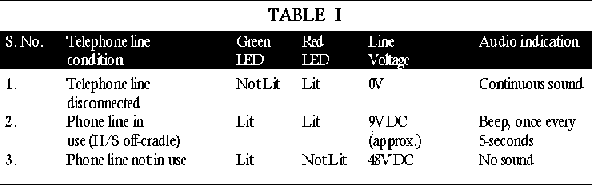
Even when the subscriber himself is using his telephone (handset off-cradle) while the vigilant circuit is on, the buzzer beeps once every 5 seconds since the vigilant circuit cannot distinguish between self-use of the subscriber lines or by any unauthorised person. Thus to avoid unnecessary disturbance, it is advisable to install the vigilant unit away from the phone. However, if one wishes to fit the unit near the telephone then switch S1 may be flipped to ?off? position to switch off the buzzer. But remember to flip the switch to ?on? position while replacing the handset on cradle.
Irrespective of telephone line polarity at the input to the circuit, proper DC polarity is maintained across C1 due to bridge rectifier comprising diodes D1 to D4. The DC voltage developed across capacitor C1 is used to check telephone line condition as per Table I. This circuit draws negligible current from telephone line; thus when it is connected to the telephone line, the normal telephone operation is not affected. The circuit may be divided into two parts. The first part comprises zener D9, transistors T1 to T4 and diode D5. It is used to verify whether telephone line loop is intact or discontinuous. The second part comprising zener D10 and transistors T5 to T10 is used to check whether telephone line is in use (or misuse) or not. The zener diode D9 (3.3V) conducts when phone line loop is intact and not broken. Zener D9 sets control voltage for transistors T1, T2 and T3 to conduct and for T4 to cut off. As a result, green LED lights but no sound is heard from the buzzer.
When phone line loop is discontinuous, no voltage is available across capacitor C1. Thus zener D9 and transistors T1, T2 and T3 do not conduct while T4 conducts. Now green LED extinguishes and a continuous sound is heard from the buzzer. When telephone line is alright but is not in use, zener D10 conducts as voltage across capacitor C1 is quite high. This results in conduction of transistors T5 and T6 and cutting off of transistor T7 (as collector of transistor T6 is near ground potential). Thus positive 9V rail is not extended to the following multivibrator circuit built around transistors T8 and T9. Consequently, the red LED is not lit and buzzer does not sound. When phone line is in use, zener D10 does not conduct. As a result, transistors T5 and T6 also do not conduct, while transistor T7 conducts. Now +9V is extended to multivibrator circuit. This multivibrator is designed such that collector of transistor T9 goes high once every 5 seconds to forward bias transistor T10 and it conducts. Thus at every 5-second interval a beep sound is heard from buzzer. The beep sound interval can be increased or decreased by changing the value of capacitor C3 while the volume can be adjusted with the help of preset VR3
If there are any problems please contact [email protected]