The Link circuitry is simple and efficient, employing just two ICs, half a dozen transistors, and a handful of garden variety components. It all runs on 12 volts and is easily assembled. You can have your own home intercom between the kitchen, the garage, the rumpus room and at your poolside ?barby? and all for less than $100!
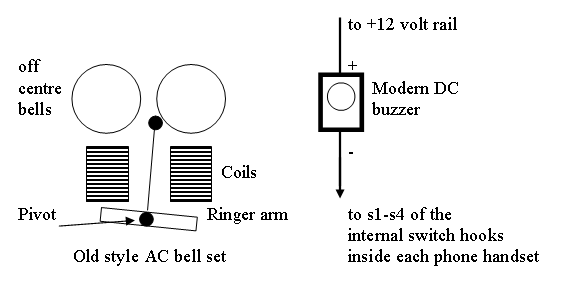
The ?Link? intercom has been designed in such a way that you can buy parts for it ?off the shelf? at just about any decent electronics retail chain. It uses old pulse dial handsets and replaces the AC bell set with a 9 volt DC buzzer. The whole circuit runs from a 12 volt regulated DC supply and is suitable for short term battery operation (eg: ?Gel Cell?). It is suitable for radio field days and sporting events (providing you can scrounge enough 4 wire cable) and may find a place in pre-schools, old folk?s homes, boy scout/girl guide halls, churches, kids? tree houses/fortresses, or maybe even more serious uses such as small offices, factories, workshops and many other applications.
The ?Link? is designed to enable one call at a time within a small area (about 100 meters from the ?black box? is about the max per handset) and is not suitable for connection to the PSTN (public network) as the voltages and currents used by the PSTN are higher, and will damage the simpler 12 volt circuitry, that employs CMOS ICs etc. The Link will run quite happily off a 12 volt regulated DC supply of only 200mA or so, and this can be a simple affair, such as a DC plug pack, wired to a 7812 regulator chip and appropriate filter caps on the output. Add some leds if you want!
Overview
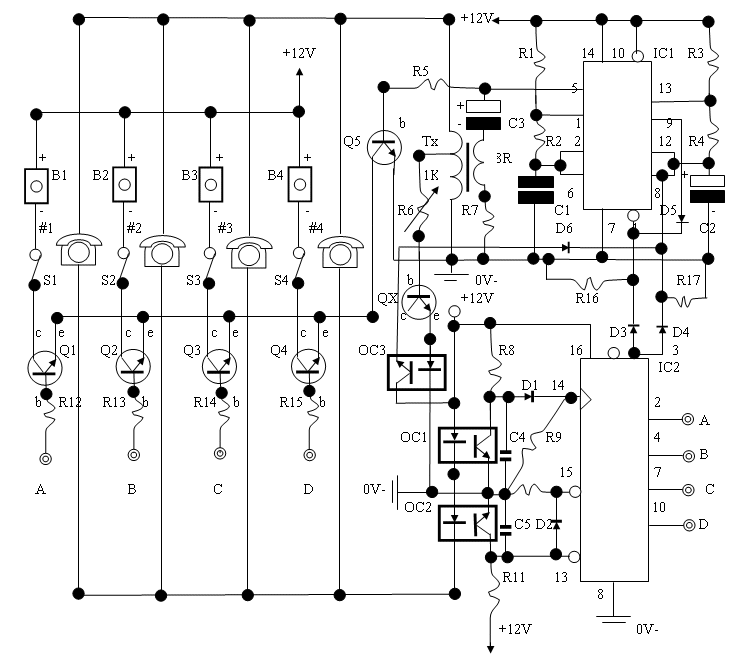
The Link telephone intercom is designed around two ICs. The first, IC1, is an NE 556 dual timer chip, which is wired up to provide dial tone, ring tone (busy tone too, which will be explained along with a few add-ons to be mentioned later on) and ring pulses for the ringer circuit attached to each line circuit. The other chip, IC 2, is a CD 4017B decade counter, which is wired to count each train of dial pulses as they are received and buffered by the two opto-couplers, OC1 and OC 2 and their associated R/C networks.
Line Circuits
Each phone handset is connected by a four wire circuit from the ?black box?. Two wires (normally tagged ?white? and ?blue? here in Oz) are for speech and dialing functions, whereas the other two (tagged locally as ?red? and ?black?) are for the ring pulses supplied by the ringer circuit to each DC buzzer inside the handsets. When a phone (eg: #1 for our discussion) is picked up in its ?off hook? condition, a DC loop is formed by the following components: DC circuitry inside the phone, the 1K winding of transformer TX, and back to 0V- earth. Taken from the +12 volts terminal, through the Leds inside OC1 and OC2 and back to the phone handset.
Making A Call
Dial tone is provided to the calling party?s phone when the Link is in its ?reset? condition (no calls in progress) via capacitor C3 and the 8 ohm winding (8R) of TX to 0v- earth. This and the other service tones are generated by IC1a, while ring pulses are generated by IC1b. When a calling party?s phone is ?off hook?, the leds force the photo transistors to switch on hard, pulling pins 13 and 14 of IC2 to 0 volts ground. When the dial inside the phone handset is pulled back and released, the collector lead of OC2?s transistor is held low at 0 volts by the slow release charging of C5. Pin 13 of IC2 is a CE (chip enable) input, and needs to stay at a logic low (near 0 volts) to enable pin 14 to count the dial pulses. So while ?impulsing? occurs, pin 13 stays low, and pin 14 alternates between logic high and low as the led emulates each dial pulse train, until the last pulse in the train is received.
Dialing Into The Register
When caller number #1 dials phone number # 4, those four pulses appear across the leds inside OC1 and OC2. The decade counter, acting as a Register (a storage device used in communications equipment for storing dialed digits) counts these pulses, turning its output pins on and off inn unison, with the last dial pulse causing the counter to rest on the last output pin that is turned on. The complete sequence for a maximum of ten pulses in the one pulse train, is (pin 3 is always at logic high at ?reset?) 2,4,7,10, and then 1,5,6,9,11 and then finally pin 3. So when the number ?4? is dialed, the counter would step through pins 2,4,7, and then land on pin 10, which is connected to phone #4?s ringer circuit via Q4?s base lead.
The Ringer Circuit
Each line circuit consists of the individual phone handset, the DC buzzer mounted inside it, the common connections to TX and the cathode of OC2?s led, as well as transistors Q1 to Q4 and common driver transistor Q5. With pin 3 of IC2 at logic high on ?reset?, diode D3 enables IC2a to provide a Dial Tone from pin 5. When a number is dialed, pin 3 of IC2 goes low on the first dial pulse, removing the logic high via D4 from pins 12 and 8 of IC1b, thus enabling it to charge up C3, and produce ring pulses to IC1a via diode D5, (from pin 9 to pin 4). After about 2 seconds, ring pulses commence, and the modulated dial tone (which then by default becomes an interrupted Ring Tone to the caller) is produced at pin 5 of IC1a, indicating the progress of the call.
True Ring Trip
When the called party answers the call, transistor QX with trimpot R6, (adjusted to detect both phones being ?off-hook?,) triggers the led and phototransistor inside OC3. This halts the ring pulses and ring tone supplied by IC1a and IC1b for the duration of that call, by supplying a logic high potential to pins 12 and 8 of IC1b via D6. When the call is over, and both parties have hung up their phone handsets (eg: back to the ?on-hook? status,) the DC loop formed by the handsets, TX and OC1/OC2 is broken. Pin 13 of IC2 returns to its reset potential of logic high, and extends this high to pin 15 (Reset) of the 4017 decade counter chip, which disables the output selected during the dialing operation, and enables pin 3 to high, thus restoring Dial Tone to the next caller via pin 4 of IC1a.
Resetting The Link
Thus the Link is fully reset and ready for another call. As you can see, it may seem a little complicated to follow the progression through a call, particularly if you haven?t been involved with phones and logic chips much before. At the end of the day, you have some simple counting, pulsing and interfacing circuitry, which will perform all the necessary tasks of a basic intercom, and all at a reasonable cost. I used some formatted matrix board for the p.c.b and IC sockets for all ICs and OC/OC2. I also found that a heat sink fin for the 7812 regulator chip was unnecessary. A box could be used for housing the Link circuitry, and some kind of screw terminal block or ID block (like a small 10 pair KRONE junction box) could be used to terminate the wiring at the box to make it look more professional. Remember these two things. If you leave a phone ?off-hook? you will lock up the Link and if you pick up a phone when someone else is dialing, wrong numbers will result. Apart from that, have fun!
Parts List:
R10 100k
R1 10k
R2 150k
R3 4k7
R4 47k
R5 2k2
R6 4k7 trimpot
R7 390R
R8 10k
R9 100k
R11 22k
R12-R15 2k2
R16 4k7
R17 4k7
C1 0.22uF
C2 47uF
C3 1uF
C4 2,200uF (power filter cap ? not shown, but wired across +12volts & 0v- ground points
Q1-Q5 BC547 n.p.n low gain
Q6 BC 549C high gain with a beta of at least 250+
D1-D7 1N4148 or 1N914 small signal diodes
IC1 NE 556 dual timer chip
IC2 CD 4017B decade counter chip
OC1-OC3 4N25 or 4N28 opto couplers
Tx 1k/8R transformer, with 1k centre tapped
B1-B4 9 volt DC buzzers mounted inside phone handsets
Miscellaneous ? wire, cable, matrix or prototyping board, solder, case, 15 volt DC 200ma plug pack power supply, phone sockets, zip ties, 7812 regulator and filter caps etc.
AustinHellier08-Oct-2003
If there are any problems please contact webmaster@electronic-circuits-diagrams.com